Ask someone who’s worked with an Indian SEO agency and didn’t have a great experience what went wrong, and the answer is usually one of three things. Communication was slow. Reporting was generic. Nobody seemed to really understand the client’s market. These are real problems, and they’re worth taking seriously — but they’re problems with specific agencies, not problems inherent to the Indian SEO market.
Ask someone who’s had an excellent experience with an Indian SEO agency and the story is completely different. Regular, substantive communication. Reports that connect SEO activity to business outcomes. A team that asked smart questions from the start and kept asking them. The kind of working relationship that makes you wonder why you ever paid more for less from an agency closer to home.
The difference between these two experiences usually comes down to a set of specific operational practices — around time zones, communication infrastructure, and reporting quality — that the best agencies have figured out and the rest haven’t.
The Time Zone Problem (And How It’s Actually Solved)
India Standard Time creates an asymmetry that’s real and worth planning for honestly rather than dismissing.
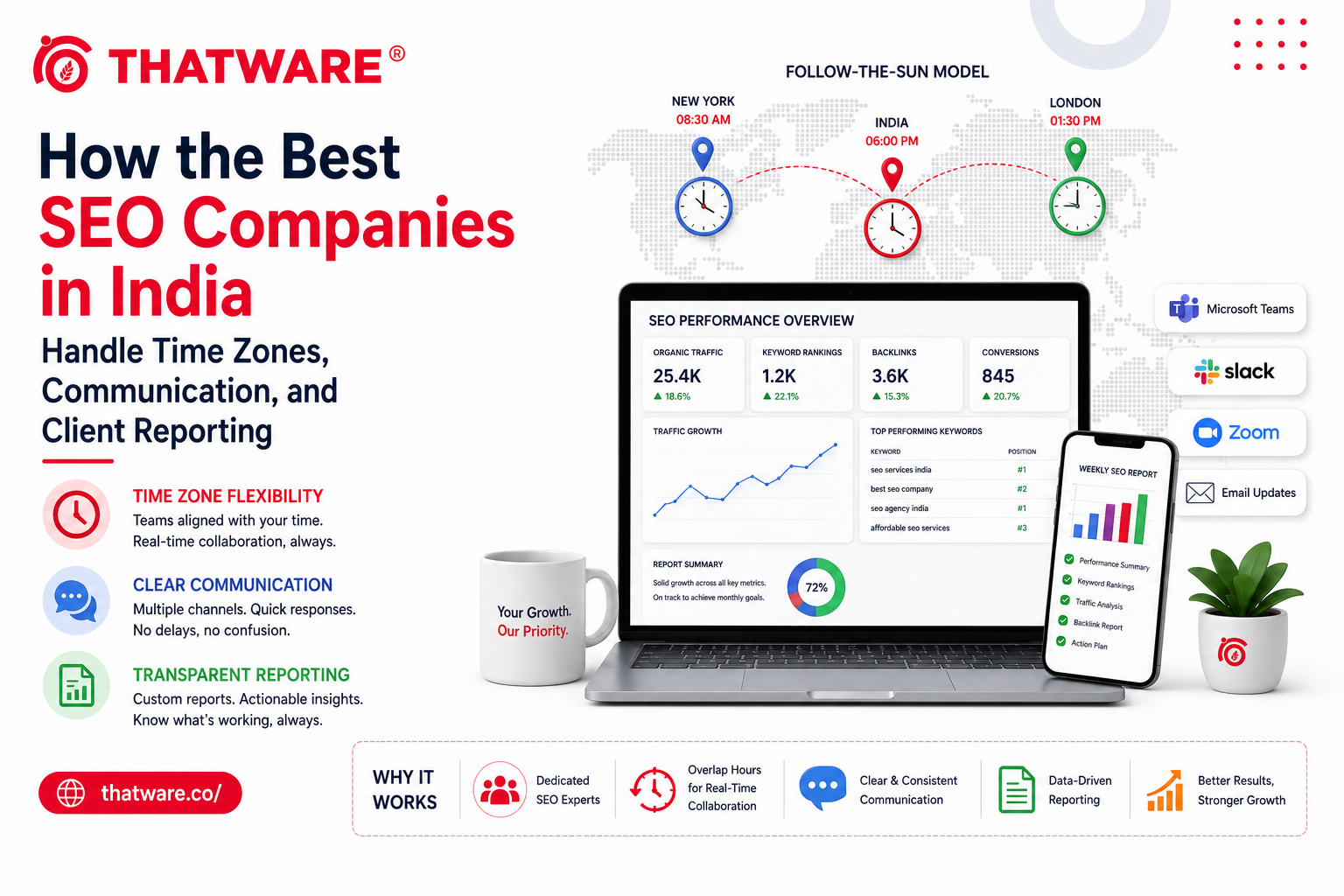
At IST +5:30, the overlap with UK working hours is roughly 1–4pm IST (8:30–11:30am UK). With US East Coast, the overlap is minimal and almost entirely requires someone to be early or late. With Australia, the overlap is more comfortable — around a 4–5 hour difference.
Agencies that handle this well don’t try to pretend the time zone doesn’t exist. They build operational systems around it.
The first is a well-defined asynchronous communication protocol. All non-urgent communication — updates, questions, work-in-progress, feedback — happens through documented channels (Slack, email, project management tools) with agreed response time SLAs. Most things don’t need to be resolved in real time, and agencies that recognise this can process and respond to client communication within a few hours of their working day beginning, which is often within the client’s same business day.
The second is scheduled synchronous windows. Most strong Indian agencies maintain a set of dedicated call times that are workable for their primary client geographies — early morning IST for US clients, standard business hours IST for UK and Australian clients. These calls are used for genuinely synchronous work: strategic decisions, complex feedback, relationship building. The efficiency of these calls tends to be higher because both sides prepare, knowing that real-time dialogue is the appropriate vehicle for complex discussion.
The third — and this is where the best agencies differ most — is proactive communication. Rather than waiting for clients to ask questions, they surface relevant information, flag potential issues, and share strategic thinking through asynchronous channels so that when the synchronous call happens, it can focus on decisions rather than updates.
What Good Communication Infrastructure Actually Looks Like
Beyond time zone management, the quality of communication infrastructure separates exceptional Indian seo company india operations from average ones.
Dedicated account contacts matter enormously. Clients should have a specific, named individual who is responsible for their account and who the client communicates with for strategic discussion. Not a shared inbox, not a rotating team lead, but one person who understands the client’s context deeply and maintains continuity across the relationship.
Project management transparency is the second component. The best agencies run client work in shared project management systems — Asana, Monday, ClickUp, or similar — where clients can see what’s being worked on, what’s been completed, and what’s coming next without having to ask. This visibility reduces the anxiety that often builds in relationships with geographic distance, because the client can see activity happening even when they’re not in direct communication.
Documentation discipline matters more in remote relationships than in co-located ones. Decisions made in calls need to be documented and shared. Strategic rationale needs to be written down, not just communicated verbally. The best agencies write well and write regularly — they treat written communication as a core professional competency, not an afterthought.
The Reporting Problem (And What Actually Fixes It)
Generic SEO reporting is one of the most consistently frustrating experiences in the agency-client relationship, and it’s particularly common in agencies that produce high-volume reports for large client bases.
You know the report. Traffic up 12% month-on-month. Keywords in top three: 47. New backlinks acquired: 23. Recommendations: improve page speed, publish more content, continue link building. Same report, different numbers, every month.
This reporting tells you that something happened. It doesn’t tell you why it happened, what it means for your business, or what should happen next as a result. It’s information without interpretation, and it requires the client to do all the analytical work that the agency should be doing.
Genuinely useful SEO reporting does several things that generic reporting doesn’t.
It connects SEO metrics to business outcomes. Not just “organic traffic increased by 15%” but “organic traffic from non-branded queries increased by 15%, which at our current conversion rate represents approximately X additional leads from organic.” The translation from SEO metrics to business impact should be in every report.
It explains why things happened. If rankings improved, which specific activities contributed to that improvement, and what’s the evidence? If a particular category of pages saw traffic decline, what’s the diagnosis? Reporting without interpretation is noise. Reporting with interpretation is intelligence.
It’s honest about what isn’t working. Generic reports tend to front-load wins and quietly omit or bury setbacks. The top seo agency india operations worth working with acknowledge when things aren’t moving as expected, explain why, and describe what’s being adjusted. That honesty is more valuable than a report full of green arrows.
It anticipates rather than just describes. The best reporting includes forward-looking analysis — what opportunities are emerging, what risks are building, what strategic adjustments are being considered based on what the data is showing.
The Onboarding Process as a Proxy for Quality
One of the most reliable signals of an Indian SEO agency’s operational quality is how they run onboarding.
Poor agencies run onboarding as a data collection exercise. They send a checklist of access requests — Google Analytics, Google Search Console, website CMS access — and then disappear into strategy development. The client answers questions but doesn’t receive much in return during the first few weeks.
Good agencies run onboarding as a discovery process. They ask substantive questions about the business model, the competitive landscape, the historical marketing context, what’s been tried before and what’s happened. They share initial observations and hypotheses. They communicate what they’re doing and why during the first few weeks, even before formal deliverables begin. They build the shared context that makes the subsequent relationship substantially more effective.
The quality of the questions asked during onboarding is a particularly strong signal. Generic questions (“what are your target keywords?”) indicate an agency applying a template. Specific questions (“you mentioned two major competitors — what do you observe about how they’re positioning themselves in search differently from each other?”) indicate an agency that’s thinking specifically about your situation.
Client Reporting Cadence and Format
On the practical mechanics: the best Indian SEO agencies have developed reporting cadences and formats that work well for international client relationships.
Monthly comprehensive reports remain the standard, and for good reason — organic search moves on a timeframe where monthly is the right resolution for most metrics. But these are supplemented by more frequent lighter-touch communication: weekly summaries of work completed and in progress, flagging anything significant that’s emerged.
The format question matters more than it’s usually given credit for. Reports that are dense with data tables but light on interpretation require significant client time to process. Reports that lead with key takeaways, translate metrics into business language, and reserve the detailed data for appendices or supplementary sections are more useful and more likely to be read and understood.
Some of the best agency-client relationships evolve toward a dashboard model — a shared live dashboard that both sides can check for current metrics, supplemented by monthly narrative analysis and quarterly strategic review. This works particularly well when the agency has set up the dashboard carefully and the client understands what they’re looking at.
The Cultural Dimension
Something that rarely gets discussed directly but influences every aspect of international agency relationships: cultural communication styles.
Indian professional communication culture has specific characteristics that can either work well or create friction in international client relationships depending on how they’re navigated.
There’s a tendency in some professional contexts to communicate optimism about timelines and outcomes — to say what the client wants to hear rather than what’s most accurate. The best agencies have actively trained against this pattern, because it consistently erodes trust when the optimistic projections don’t materialise.
There’s also a strong collaborative orientation that, when well-channelled, produces excellent responsiveness to client feedback and willingness to adapt. When less well-channelled, it can produce a reactive relationship where the agency waits for client direction rather than taking strategic initiative.
The agencies that have figured this out build cultures of direct, honest communication — of saying “we’re not confident about that timeline and here’s why” and “we think this approach isn’t working and here’s what we’d like to try instead.” That directness is what makes international relationships work well over time, and it’s something specific agencies have invested in cultivating.
Making the Evaluation Decision
When evaluating Indian SEO agencies for an international client relationship, the operational factors described here are as important as the technical and strategic capability assessment.
Ask specifically about time zone management: what’s your protocol for urgent issues? What are the standard response time SLAs for non-urgent communication? When can we expect overlap availability for synchronous calls?
Ask for a sample report from a current client in a similar situation to yours. Review it critically: does it connect SEO activity to business outcomes? Does it explain why things happened? Is it honest about what isn’t working?
Ask about the onboarding process in detail: what will you need from us, what will you produce, and what will we know about each other by the end of onboarding that we don’t know now?
The answers reveal whether the operational infrastructure is genuinely in place — and whether this is an agency that’s figured out how to do international relationships well.